
How to Budget as a Couple Without Fighting About Money
Money fights aren’t really about money. They’re about trust, control, and two people who grew up with completely different ideas of what “normal” spending looks like. One of you sees a $40 latte habit as self-care. The other sees it as a leak in the boat. Neither of you is wrong — you’re just running different software.
The good news: couples who budget together don’t fight less because they agree on everything. They fight less because they’ve built a system that catches disagreements before they turn into a 11 p.m. kitchen-table blowup over a credit card statement.
Here’s how to actually do that.
1. Have “The Talk” Before You Build a Spreadsheet
Most couples skip straight to the app or the spreadsheet. That’s backwards. Before you touch a single number, answer these together:
- What did money look like in your house growing up?
- What’s one financial fear you have that you’ve never said out loud?
- What does “financially safe” feel like to you — a number in savings, no debt, something else?
This isn’t a therapy session (though sometimes it turns into one, and that’s fine). It’s context. You can’t build a budget that works for two people if you don’t know what each of you is actually afraid of.
2. Pick a Money Structure That Matches Your Relationship — Not Your Friends’ Relationship
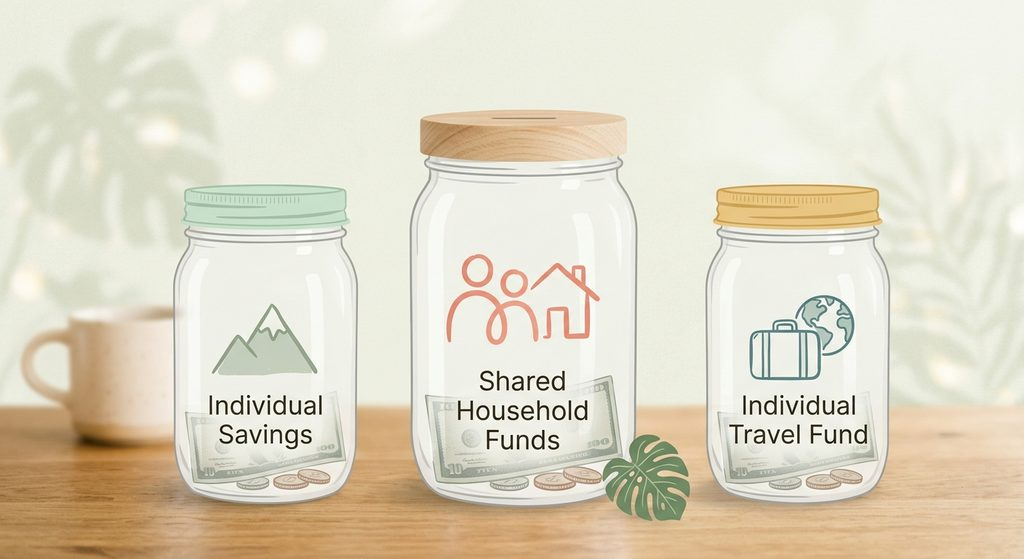
There’s no one “right” way to combine finances. The three most common setups:
- All-in-one: Every dollar goes into shared accounts. Simple, but can feel suffocating if one partner values independence.
- Yours, mine, and ours: You each keep personal accounts, plus a shared account for joint bills. Popular with couples who married later or merged very different financial habits.
- Proportional contribution: If incomes are uneven, each partner contributes a percentage of their income to shared expenses, not a flat 50/50 split. Feels fairer when there’s a real income gap.
Pick the one that reduces resentment, not the one that looks best on Instagram.
3. Schedule a Recurring “Money Date” — and Keep It Short

The single biggest predictor of couples who don’t fight about money isn’t income. It’s whether they talk about money on a schedule instead of only during a crisis.
- Once a week or every two weeks, 20–30 minutes, same day/time.
- No phones, no “just one more thing,” no ambush topics (“also, why did you spend $300 at Target”).
- Structure it: review the month so far → flag anything unusual → talk about one upcoming decision (a trip, a purchase, a goal). That’s it.
Ambush conversations feel like attacks. Scheduled ones feel like teamwork.
4. Give Each Person a “No Questions Asked” Fund
Even in the tightest joint budget, carve out a small amount — $50, $100, whatever your budget allows — that each partner can spend on literally anything with zero explanation required.
This one line item prevents more fights than any spreadsheet formula. It turns “why did you buy that” into a non-issue, because that money was never up for debate in the first place.
5. Use One Shared Tool — Not Two People’s Mental Math
Pick a single system you both actually use: a shared spreadsheet, a budgeting app with a partner feature, or a simple shared note. The fights usually aren’t about the numbers — they’re about one partner feeling like they’re the only one tracking anything.
Whatever tool you pick, the rule is: if it’s not in the shared system, it doesn’t exist yet as a “decision” — it’s just a conversation.
6. Fight About the System, Not About Each Other
When a disagreement does come up (it will), redirect it: instead of “you always overspend,” try “our system didn’t catch this — how do we fix the system?” That reframes the conversation from a character attack to a shared problem-solving exercise, which is a much easier place for either of you to stay calm.
The Bottom Line
Budgeting as a couple isn’t about becoming financially identical. It’s about building enough structure — a shared method, a recurring check-in, a little bit of individual freedom — that money stops being the thing you argue about and starts being the thing you manage together.