
How to Start Investing With Just $50 a Month
You don’t need a trust fund, a finance degree, or thousands of dollars sitting around to start investing. If you’ve been putting it off because $50 feels too small to matter, here’s the truth: it’s not about how much you start with — it’s about starting at all. This is exactly how to invest in stocks for beginners with little money, using a real, repeatable system instead of guesswork.
Why $50 a Month Actually Works
Fifty dollars a month sounds small until you look at what consistency does over time. Investing isn’t about timing the market with a big lump sum — it’s about time in the market. A steady $50/month contribution, left alone to grow, builds real momentum through compound growth: your returns start earning their own returns.
The real enemy isn’t a small starting amount. It’s waiting for “someday” when you have more.
Step 1: Open a Brokerage Account With No Minimum
You don’t need a fancy setup — just a place to put the money to work. Look for a broker with:
- No account minimums
- No trading fees on stocks/ETFs
- Fractional share investing (so $50 can buy a slice of an expensive stock or fund, not just whole shares)
Most major brokers (Fidelity, Schwab, Vanguard, and mobile-first apps like SoFi or Robinhood) now meet all three.
Step 2: Don’t Pick Stocks — Pick a Fund
With $50, the smartest move isn’t betting on one company. It’s buying a low-cost index fund or ETF that spreads your money across hundreds of companies at once.
- A broad market ETF tracking the S&P 500 gives you instant diversification.
- It historically averages strong long-term growth, without the risk of one bad company tanking your whole investment.
- Fractional shares mean you don’t need $400+ to buy a single share — your $50 buys a proportional slice.
This single decision is what separates “investing” from “gambling.”
Step 3: Automate It So You Never Have to Decide Again

Willpower runs out. Automation doesn’t.
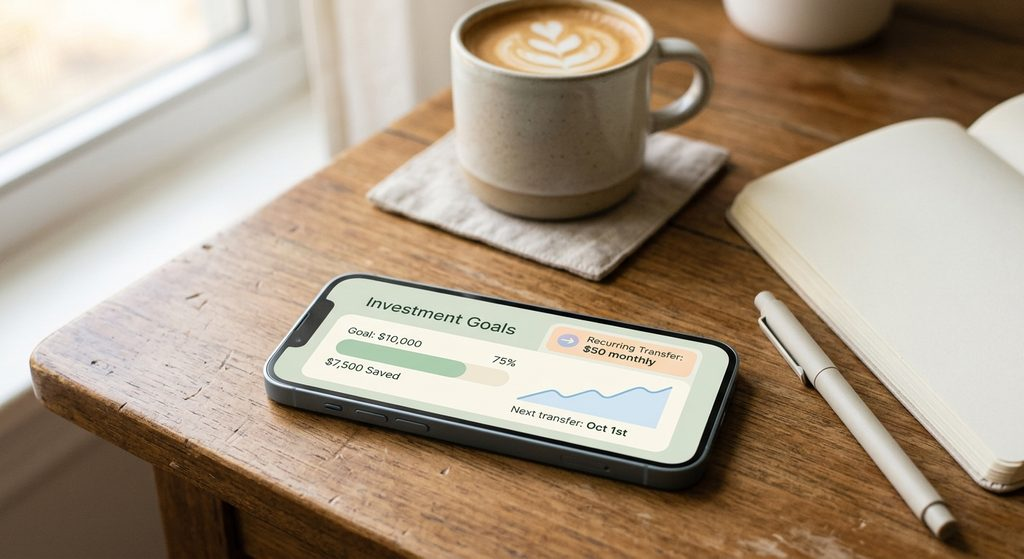
- Set up a recurring transfer of $50 on the same day each month — ideally right after payday.
- Treat it like a bill you owe yourself, not a leftover you’ll get to “if there’s extra.”
- Turn on automatic dividend reinvestment so any payouts buy more shares instead of sitting in cash.
Step 4: Increase It Gradually — Not All at Once
You don’t have to stay at $50 forever. Every time you get a raise, pay off a debt, or cut a subscription, redirect even $10–20 more into that recurring transfer. Small increases compound just like the investment itself.
What $50 a Month Can Actually Become
This isn’t about getting rich overnight — it’s about building a habit that compounds. The account that starts at $50/month and grows with you is a fundamentally different trajectory than the account you never opened because you were waiting to “have enough.”
The Bottom Line
You don’t need $5,000 to start investing. You need a brokerage account, one low-cost fund, and a recurring transfer you never have to think about again. That’s the whole system — and it works exactly the same whether you start with $50 or $5,000. The only real mistake is not starting.