
Backdoor Roth IRA: A Step-by-Step Guide for High Earners
You’re doing well. Maybe too well, according to the IRS.
If your income has climbed past the Roth IRA limits, you’ve probably run into this frustrating discovery: the retirement account everyone raves about — tax-free growth, tax-free withdrawals in retirement, no required minimum distributions — has a velvet rope, and you’re apparently not on the list.
Good news: there’s a legal, widely-used workaround. It’s called the backdoor Roth IRA, and despite the slightly sketchy name, it’s a completely above-board strategy that high earners have been using for over a decade. Let’s break down exactly how it works.
Wait, why can’t I just open a Roth IRA?
Roth IRAs have income limits. For 2026, if you’re a single filer with a modified adjusted gross income (MAGI) above the phase-out range, or married filing jointly above the joint phase-out range, you can’t contribute directly to a Roth IRA. The exact thresholds adjust annually, so check the current IRS limits before you start.
That’s the whole problem. And it’s an annoying one, because Roth accounts are especially valuable when you’re young(ish) and earning well: you pay taxes now, at your current rate, and then let decades of compounding happen completely tax-free.
The loophole (that isn’t really a loophole)
Here’s the trick: there’s no income limit on contributing to a traditional IRA (though your ability to deduct that contribution may be limited if you have a workplace plan). And there’s no income limit on converting a traditional IRA to a Roth IRA either.
So the “backdoor” is simply:
- Contribute to a traditional IRA (non-deductible, since you’re over the limit).
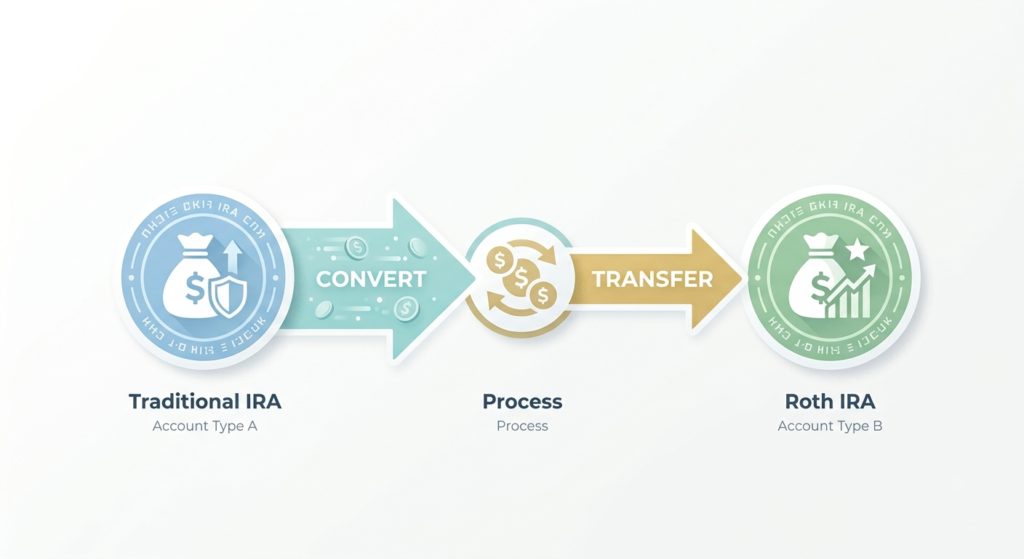
- Convert that traditional IRA to a Roth IRA.
That’s it. You’re using the front door for step one and step two — there’s no secret handshake. The IRS has acknowledged this strategy is legitimate, and it’s been standard practice in the financial planning world for years.
Step-by-Step Guide
Step 1: Open a traditional IRA (if you don’t already have one)
Any major brokerage — Fidelity, Schwab, Vanguard — will let you open one online in about ten minutes. If you already have a traditional IRA, you can use that one, but see the “pro-rata rule” warning below before you do.
Step 2: Make a non-deductible contribution
Contribute up to the annual IRA limit. Since your income is too high to deduct this contribution, you’re contributing with after-tax dollars — money you’ve already paid income tax on.
Important: File IRS Form 8606 with your tax return for the year you make this contribution. This form tracks your “basis” — the after-tax money you put in — so you don’t get taxed on it again later. Skipping this form is the single most common (and most costly) mistake people make with this strategy.
Step 3: Convert the funds to a Roth IRA
Once the money has settled in your traditional IRA (many people wait a few days to a couple of weeks, though some convert almost immediately), initiate a Roth conversion. Most brokerages let you do this online with a few clicks — it’s often labeled something like “Convert to Roth IRA.”
Step 4: Pay taxes on any gains
If you converted quickly and the money didn’t have time to grow, you may owe little to nothing in taxes on the conversion. If the funds sat in the traditional IRA and earned interest or investment gains before you converted, that growth portion is taxable as ordinary income in the year of conversion. This is another reason many people convert quickly, to minimize the taxable gain.
Step 5: Report it correctly at tax time
You’ll receive a Form 1099-R from your brokerage reporting the distribution from the traditional IRA. Combined with your Form 8606, this shows the IRS that you already paid tax on the contribution, so only the growth (if any) gets taxed again.
The Pro-Rata Rule: The Part That Trips Everyone Up
This is the detail that catches people off guard, so pay attention.
If you have any existing pre-tax money in traditional IRAs, SEP IRAs, or SIMPLE IRAs (across all your IRA accounts, not just the one you’re converting), the IRS treats all your IRA money as one combined pot when calculating the taxable portion of a conversion. You can’t just convert the “after-tax” sliver and call it tax-free.
Example: Say you have $18,000 sitting in a traditional IRA from an old 401(k) rollover, all pre-tax. You then contribute a new $7,000 non-deductible contribution and try to convert just that $7,000. The IRS doesn’t let you cherry-pick. It calculates the taxable percentage based on your total IRA balance: in this case, roughly 72% of any amount you convert would be taxable, because 72% of your combined IRA money is pre-tax.
If this applies to you, there are a couple of common workarounds:
- Roll pre-tax IRA money into your employer’s 401(k), if your plan allows incoming rollovers. This removes it from the pro-rata calculation entirely, since the rule only looks at IRA balances, not 401(k) balances.
- Do the conversion anyway and pay the pro-rated tax, if rolling into a 401(k) isn’t an option or doesn’t make sense for you.
A Few Other Things Worth Knowing
- There’s no income limit on the backdoor strategy itself. The whole point is that it sidesteps the Roth income cap.
- This isn’t the same as a “mega backdoor Roth,” which involves after-tax 401(k) contributions and is a separate (bigger, more complex) strategy for those with access to the right kind of employer plan.
- Timing matters less than people think, but it’s not irrelevant. Converting quickly minimizes taxable growth, but there’s no strict rule requiring same-day conversion.
- This strategy could change. Congress has floated closing this loophole in past legislative proposals. It hasn’t happened yet, but it’s worth keeping an eye on if this is a core piece of your retirement plan.
Is It Worth the Hassle?
For a lot of high earners, yes. A few thousand dollars a year in tax-free growth space, compounded over 20-30 years, adds up meaningfully. And once you’ve done it once, the annual process takes maybe 20 minutes.
That said, everyone’s tax situation is different, especially if the pro-rata rule applies to you. This isn’t financial or tax advice tailored to your specific situation, so it’s worth a conversation with a CPA or fee-only financial planner before you execute your first conversion, particularly if you have existing pre-tax IRA balances.
Have questions about optimizing your retirement accounts? Drop a comment below or check out our other guides on tax-advantaged investing.