
The 50/30/20 Rule Doesn’t Work for Millennials — Here’s What Does

If you’ve ever opened a budgeting app or read a “how to manage your money” article, you’ve run into the 50/30/20 rule: 50% of your income goes to needs, 30% to wants, and 20% to savings. It’s clean, it’s simple, and it sounds achievable.
It’s also, for a huge number of millennials, basically impossible.
The rule was popularized in 2005, before student debt ballooned, before rent ate a third of paychecks in most major cities, and before childcare costs rivaled mortgage payments. It was built for a different economy. If you’ve tried to follow it and felt like you were failing, you probably weren’t — the framework just doesn’t match your reality.
Why the Math Breaks Down
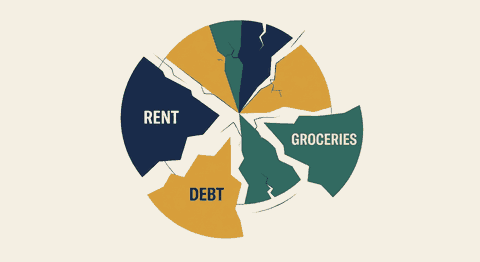
“Needs” are eating more than 50%. In many U.S. metro areas, rent alone can consume 35–45% of take-home pay for a single earner. Add student loan payments, health insurance premiums, and car payments, and “needs” routinely hit 65–75% of income before a single “want” gets purchased. The rule assumes needs are cheap and stable. For a lot of millennials, they’re neither.
Debt isn’t a “want” or a clean 20%. The rule lumps debt repayment into the 20% savings bucket, alongside retirement contributions and emergency fund building. But if you’re carrying $40,000 in student loans, that 20% can get consumed entirely by minimum payments, leaving nothing for actual savings.
Income isn’t always steady. The rule assumes a predictable paycheck. Between freelance work, contract gigs, and variable commission structures, a growing share of millennials don’t have the same income every month, which makes fixed percentages hard to apply consistently.
It doesn’t account for catch-up needs. Many millennials started saving for retirement later than previous generations, thanks to graduating into the 2008 recession or gig-economy years without employer benefits. A flat 20% doesn’t address the reality that some people need to save more than that to catch up.
What Actually Works Instead
1. The Reverse Budget (Pay Yourself First, Then Adjust)
Instead of allocating percentages to needs and wants first, flip the order:
- Set your savings/debt-payoff number first — even if it’s small.
- Cover true fixed needs (rent, insurance, minimum debt payments).
- Whatever’s left is your flexible spending — no fixed percentage required.
This works better for irregular income and high-cost-of-living situations because it doesn’t assume your needs will conveniently fit into 50%. It just makes sure savings happens before lifestyle spending, even if the percentages look nothing like 50/30/20.
2. The Values-Based Percentage Budget
Rather than generic categories, build percentages around what actually matters to you:
- Housing: whatever it actually costs (often 35–45%, and that’s okay)
- Debt payoff: a fixed number until it’s gone, then redirected to savings
- Non-negotiables (childcare, insurance): whatever they cost
- Everything else: split between savings and discretionary spending
The goal isn’t hitting arbitrary percentages — it’s knowing exactly where your money goes and making sure debt and savings aren’t an afterthought.
3. The Two-Bucket Method for Variable Income

If your income changes month to month:
- Bucket 1 — Baseline: Calculate your lowest expected monthly income. Budget your fixed needs against that number only.
- Bucket 2 — Overflow: Anything earned above your baseline gets split between savings, debt payoff, and discretionary spending using whatever ratio fits your goals.
This removes the guesswork of budgeting against income you might not actually receive, and it prevents the common freelancer trap of overspending in a good month and scrambling in a lean one.
4. The Debt-Adjusted Framework
If you’re carrying significant debt, separate it entirely from your “savings” bucket:
- Needs: fixed costs only
- Debt payoff: a dedicated line, calculated based on your actual payoff timeline goal — not squeezed into 20% alongside retirement savings
- Wants: what’s left after needs and debt
- Savings: even a small amount (5%, 3%, whatever’s realistic) rather than nothing
This keeps debt payoff from silently swallowing your entire savings allocation, which is often what happens under the traditional rule without anyone noticing.
The Real Takeaway
The 50/30/20 rule isn’t wrong because it’s a bad idea — it’s wrong because it assumes a cost-of-living reality that doesn’t match most millennials’ actual expenses. A framework that assumes needs cost half your income and debt fits neatly into a fifth of it just doesn’t hold up against 2026 rent prices, healthcare costs, and student debt balances.
The better approach isn’t a stricter percentage — it’s a framework that starts with your actual numbers (income, fixed costs, debt) and builds outward, rather than forcing your life to fit a formula designed twenty years ago.
If you’re budgeting and constantly missing the 50/30/20 targets, the problem probably isn’t your spending habits. It’s the rule.
One Comment