
Freelance Taxes 101: What to Set Aside Before You Spend It
Nobody warns new freelancers about this clearly enough: the moment a client pays you, that full amount is not actually yours. A chunk of it already belongs to the IRS — you just haven’t sent it yet. Spend the whole payment and you’ll find that out the hard way in April.
Here’s exactly how much to set aside, why it’s more than most people expect, and how the quarterly system actually works.
Why Freelance Taxes Feel So Different From a W-2 Job
As an employee, your employer automatically withholds taxes from every paycheck — you never see that money, so you never miss it. As a freelancer, nothing is withheld. The full payment lands in your account, and it’s entirely on you to set aside your own tax money and send it to the IRS yourself, usually four times a year.
This is the single biggest reason freelancers get blindsided at tax time — not because the math is complicated, but because the money was never separated out in the first place. If your income also fluctuates month to month, our post on why the 50/30/20 rule doesn’t work for millennials covers a budgeting method built specifically for variable income.
The Self-Employment Tax Rate Explained
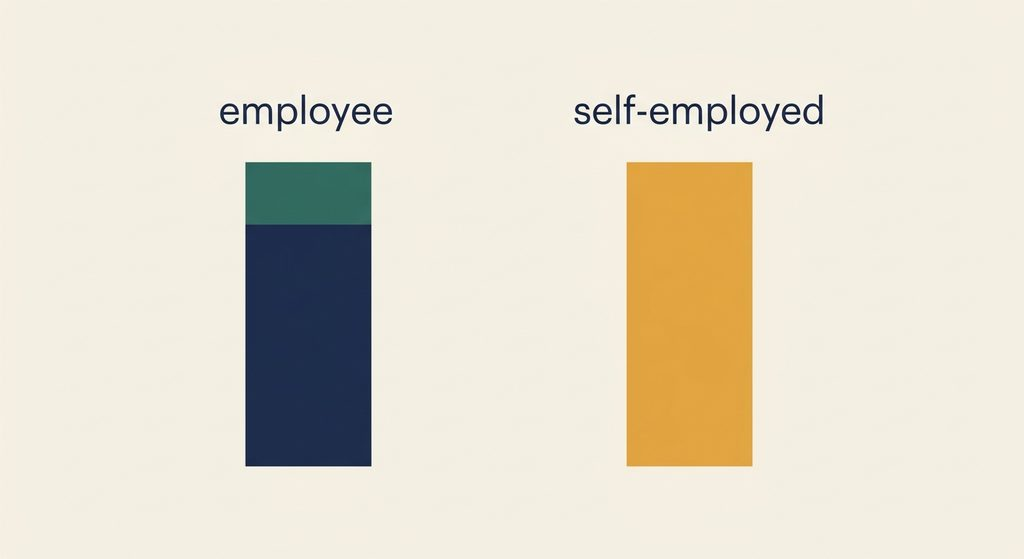
Here’s the part that surprises almost every new freelancer: when you’re an employee, you and your employer split the 15.3% Social Security and Medicare tax — you pay 7.65%, they pay the other half. When you’re self-employed, you are both, so you pay the entire 15.3% yourself. This is called self-employment tax (SE tax), and it applies once your net self-employment earnings hit $400 for the year.
For 2026, the 15.3% rate applies to net self-employment income up to the Social Security wage base (a bit above $175,000), with a 2.9% Medicare-only portion continuing above that threshold. There is some relief: you can deduct half of your self-employment tax as an above-the-line deduction, which reduces your taxable income.
How Much to Actually Set Aside
The rule of thumb that shows up consistently across tax professionals and calculators: set aside 25-30% of every payment you receive, in a separate savings account you don’t touch for anything else. If you’re a higher earner or live in a high-tax state, bump that up to 30-35%.
This percentage covers three things stacking on top of each other:
- Self-employment tax (roughly 14-15% after the deduction)
- Federal income tax (typically 10-24% depending on your bracket)
- A buffer for state income tax, if your state has one
A worked example: a single freelancer with $60,000 in net self-employment income might owe roughly $13,000 in combined federal tax — about 22% of that income. Setting aside 27-30% builds in a cushion for state taxes and any miscalculation, so you’re not caught short.
Quarterly Estimated Taxes: Why They Exist and When They’re Due
The IRS runs on a “pay-as-you-go” system — they expect tax payments as you earn the income, not just once a year in April. If you expect to owe $1,000 or more for the year, you’re generally required to make estimated payments four times a year.
The 2026 due dates:
- Q1: April 15, 2026
- Q2: June 15, 2026
- Q3: September 15, 2026
- Q4: January 15, 2027
Note that these don’t line up with actual calendar quarters — a common early mistake — and the IRS charges an underpayment penalty (currently around 8% annually, calculated like interest) if you don’t pay enough throughout the year.
The Safe Harbor Rule: How to Avoid Penalties With Irregular Income
If your income fluctuates month to month, precisely predicting your tax bill in advance is genuinely difficult. The safe harbor rule solves this: as long as you pay either 100% of what you owed last year (110% if your income was over $150,000) or 90% of what you’ll owe this year, you avoid underpayment penalties — even if your final bill ends up being higher.
In practice, most self-employed people default to the prior-year method since it’s simple and certain: take last year’s total tax bill, divide by four, and pay that amount each quarter.
What Reduces Your Tax Bill (So You’re Not Just Guessing)
Since you’re taxed on net income — after business expenses — deductions matter more for freelancers than almost anyone else. A few of the highest-impact ones:
- Home office deduction, if you have a dedicated workspace
- Health insurance premiums — self-employed people can generally deduct 100% of premiums for themselves and dependents, even without itemizing
- Retirement contributions — a Solo 401(k) or SEP-IRA lets you shelter a significant chunk of net income from taxes while building retirement savings at the same time
- Business expenses — software subscriptions, equipment, a portion of internet/phone bills used for work, and similar costs
A Simple System That Actually Works
- Open a separate savings account for taxes only — don’t mix it with your regular checking.
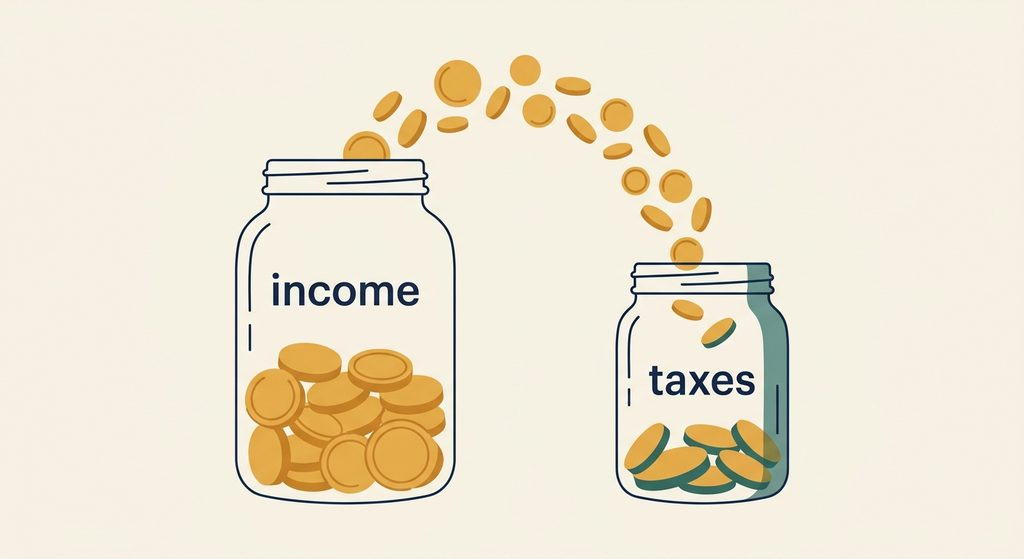
- Every time you get paid, immediately transfer 25-30% into that account before you spend or budget the rest.
- Pay your quarterly estimate from that account on each due date.
- Recalculate periodically if your income changes significantly during the year.
- Track deductible expenses year-round, not just in a scramble before filing.
The Bottom Line
Freelance taxes aren’t more complicated than W-2 taxes — they’re just no longer invisible. The number that catches people off guard isn’t a hidden fee, it’s simply the tax that used to be withheld automatically before you ever saw the money. Set aside 25-30% of every payment from day one, and by the time your quarterly deadline arrives, it’s a routine transfer instead of a financial emergency.
This post reflects federal tax rates, thresholds, and deadlines as of September 2026. Tax rules change and vary by state — consult a tax professional for guidance specific to your situation.